A 300 year old Family Treasure – RSN Embroidery Studio
19th January, 2026
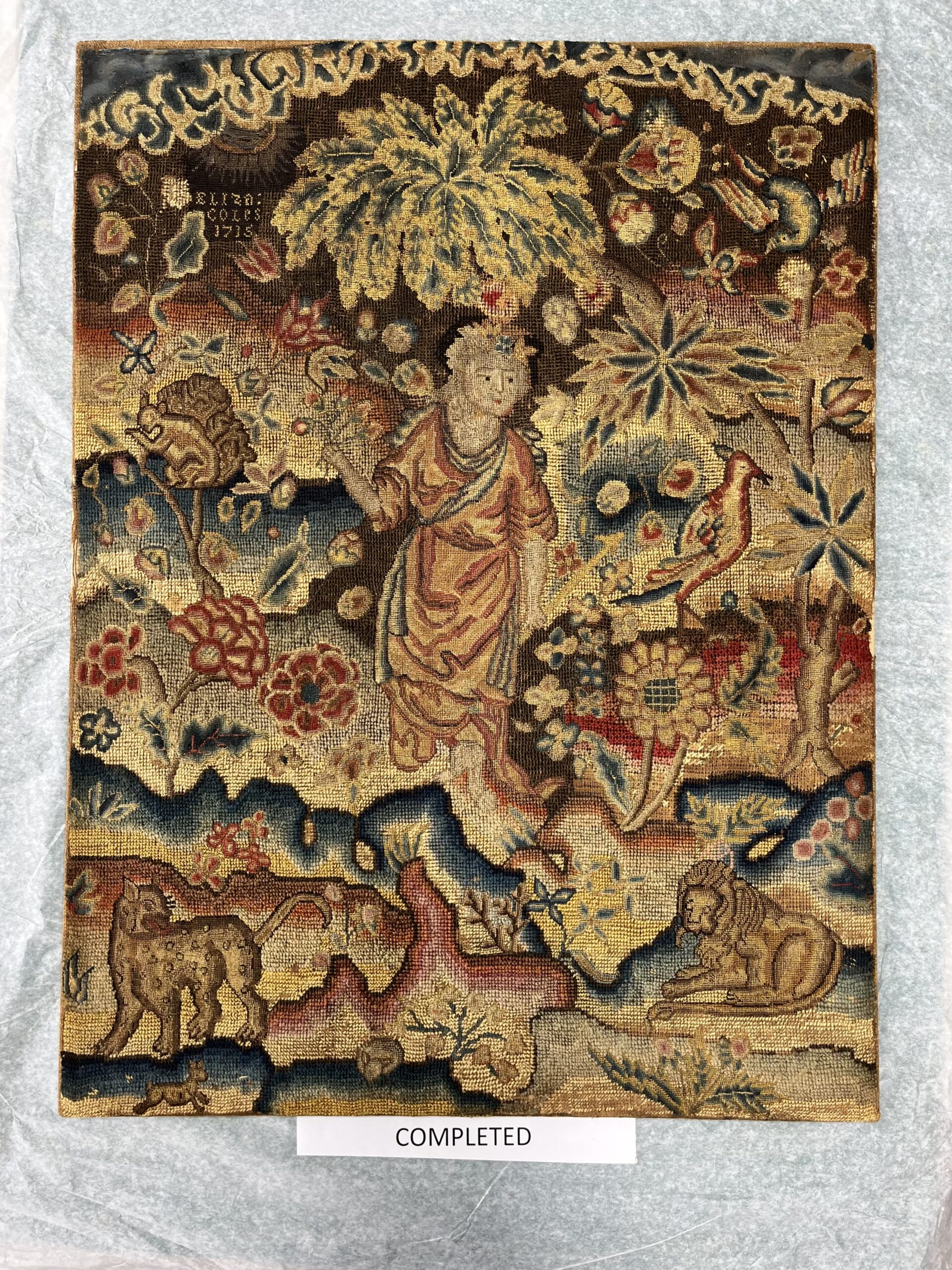
At the RSN Embroidery Studio, we are entrusted with many pieces of embroidery that hold deep family significance, but this particular piece is one of the oldest works that has remained within the same family from it’s creation. This canvaswork embroidery was stitched by the client’s ancestor in 1715 and has been kept within the family for over 300 years.
The family researched the embroiderer extensively and knew a great deal about her life, making her presence feel very close, not only to them, but to us as well. This knowledge brought with it a strong sense of responsibility to ensure that this treasured embroidery is cared for, for future generations of the family.
The piece has clearly been loved and valued throughout its life. The client remembers her grandparents having it reframed to protect it while still allowing it to be enjoyed. Considering its great age, it remains in very good condition, with no holes or broken threads.
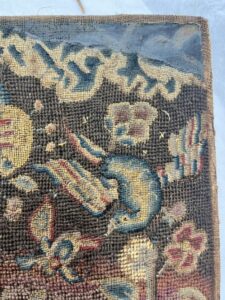
It appears that the embroidery may originally have been made for a different type of frame, possibly a small firescreen with a curved top. This is suggested by the small areas of plain canvas at the top corners, which have been carefully painted in a colour matching the stitched background to disguise the absence of stitches. While the painting works visually with the square corners of the current rectangular frame, it hints at an earlier form. It is not clear when this alteration was made, but it forms part of the embroidery’s biography, one chapter among many in its long life.
We are very fortunate to work with Dr Isabella Rosner, the RSN’s Curator of Textiles, and we occasionally ask her to examine clients’ pieces to see if she can add historical context. Isabella had the following to say about this embroidery:
“The embroidery is wonderfully typical of the time. In the early 18th century, it was common for girls nearing the end of their embroidery education to make canvaswork firescreens, chair backs, seat covers, and similar furnishings. The original curved top of this piece suggests it began life as a firescreen.
The design takes inspiration from exotic imagery, seen in the craggy rocks, the bird with outstretched wings in the top right corner, and the palm tree beneath which the central figure stands. I’m especially interested in the sunflower to the right of the figure, as this style of sunflower appears more often in American canvaswork than British, making it a relatively rare inclusion here.
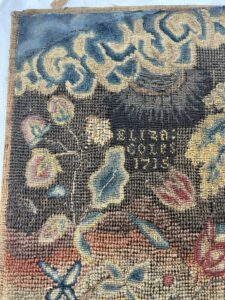
The fact that the maker stitched her name and the date is also quite unusual, as most canvaswork pieces of this type are unsigned and undated. Overall, it is a really lovely example of early 18th-century domestic embroidery.”
But the story does not end there.
When we removed the embroidery from its frame, we discovered an exciting and unexpected find: a fragment of wallpaper attached to the wooden board behind the embroidery. Isabella immediately recognised its potential significance. With the client’s permission, she shared an image with an associate, an Assistant Curator of China at a London museum.
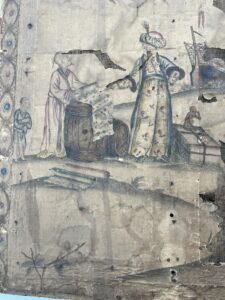
They had not encountered a piece quite like it before and felt it was particularly significant, especially as it depicts a trade figure, possibly linking it to the Chinese–British silk trade of the 18th century. Notably, whoever reframed the embroidery in the past, perhaps more than once over its 300-year history, had clearly felt the wallpaper was important enough to keep with the piece.
Originally attached directly to the mounting board, the wallpaper raises intriguing questions. Was this a deliberate act of preservation, or an example of reuse and repurposing? Like the embroidery itself, it adds another layer to the object’s rich and evolving story.
Do you have an object you would like made, restored, or conserved?
Why not get in touch with the RSN Embroidery Studio Team or visit the website today for bespoke embroidery commissions, restoration and conservation services.