Restoring Family Samplers
28th January, 2026
The RSN Embroidery Studio team particularly enjoy working on pieces that hold a deep personal connection for their owners, especially when that connection spans generations. Often, we never meet the future custodians of these objects, but in this commission, we were fortunate enough to do so.
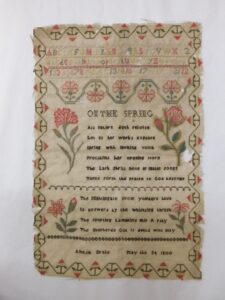
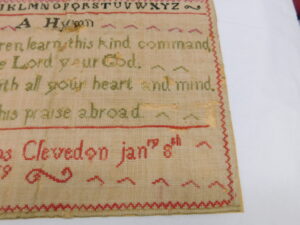
These samplers were worked by the client’s many-times-great-grandmothers: one by Amelia Drake, dated 1800, and the other by Sarah Clevedon, dated 1819. Both pieces were framed and showed evidence of historic moth damage. However, upon removing the frame backs and samplers, no active pests were found.
Both samplers needed to be removed from their frames and wooden stretchers prior to cleaning, allowing for the careful removal of surface dust, ingrained dirt, and insect residue. When embroideries were originally mounted onto wooden stretchers, they were often secured with nails which, over time, can rust and deteriorate the surrounding fabric.
Additionally, the samplers lacked full support across their entire surfaces, being held only at the edges. This left the fabric vulnerable to insect access and allowed the weight of the embroidery to place strain on the fibres, causing gradual distortion over time.
Wooden stretchers can also contribute to colour change within a sampler for several reasons: they may trap dust and dirt against the textile, or the wood itself may cause discolouration where no protective fabric layer is present between the stretcher and the embroidery.
The samplers were fully supported and secured before being mounted onto fabric-covered, conservation-grade board, ready for placement into new frames. Areas of damage were stabilised to prevent further deterioration in weakened sections.
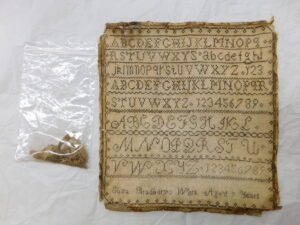
In addition to these two samplers, the client also owned a third sampler worked by a different ancestor, Eliza Bradbury, who was only seven years old when she completed her piece. The client is currently researching Eliza and working to add her to their family tree. All three samplers underwent a similar conservation process prior to reframing, which will help extend their lives, provided they are displayed out of direct sunlight and in a stable, even temperature.
Upon completion, the conserved samplers were collected by the client’s son and grandson, both of whom were fascinated by the conservation process and looking forward to becoming their future custodians.
Do you have an object you would like made, restored, or conserved?
Why not get in touch with the RSN Embroidery Studio Team or visit the website today for bespoke embroidery commissions, restoration and conservation services.
Read more stories from the RSN Embroidery Studio