See all the classes, events, talk, exhibitions and more happening between March and June!
Day & Evening Classes

RSN Studio: Plum Blossom Branch, Hampton Court Palace, Friday 20 – Sunday 22 March

Walter Crane Inspired Iris, Online, Wednesday 8 – 29 April

Medieval Starflower, Online, Monday 13 April – Monday 1 June

Walter Crane Inspired Iris, Hampton Court Palace, Saturday 18 & Sunday 19 April

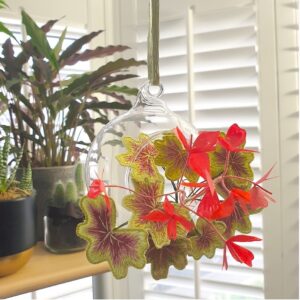
Geranium 3D, Online, Monday 20 – Monday 27 April

RSN Studio: Plum Blossom Branch, Online, from Tuesday 21 April

Experimental 3D Embroidery, Online, Wednesday 29 April – Wednesday 20 May

Great Sundew, Hampton Court Palace, Saturday 2 May

Introduction to Stumpwork – The Orangery Garden, Hampton Court Palace, Saturday 9 May

RSN Studio: Nature’s Bounty, Online, Saturday 9 – Saturday 15 May

Silk and Metal thread embroidered Elephant Hawk-Moth, Online, Tuesday 12 – Tuesday 26 May

RSN Studio: Nature’s Bounty, Hampton Court Palace, Saturday 23 & Sunday 24 May

Introduction to Appliqué: Pet Silhouette, Hampton Court Palace, Saturday 30 May


Taster sessions
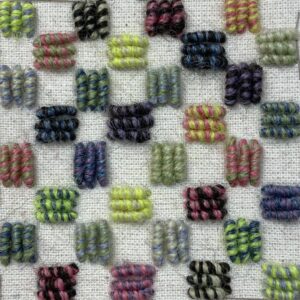
Hand Embroidery: Skills & Studies – Online, Tuesday 24 March


Experience Classes
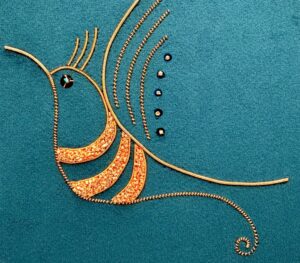
Stylised Goldwork Hoopoe Bird inspired by Canticle of the Birds at the Aga Khan Centre, London, Saturday 28 March

‘Queen’s Wing’ embroidery inspired by Zandra Rhodes exhibition at the Holburne Museum, Bath, Saturday 18 April – 1 space left

Goldwork Wyvern: Divine & Mythical Creatures Experience Class, Hampton Court Palace, Wednesday 13 May – 1 space left


Online Talks

Fashioning the Crown: A Story of Power, Conflict and Couture, with Justine Picardie and Dr Isabella Rosner, Wednesday 18 March

Exploring 17th-Century Embroidered Boxes, with Dr Isabella Rosner, Wednesday 25 March


Exhibitions
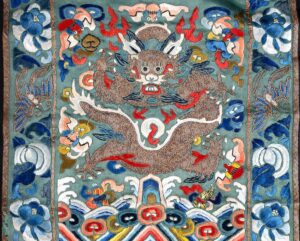
Divine and Mythical Creatures from the RSN Collection & Archive’ NEW exhibition, Hampton Court Palace, booking now until June 2026
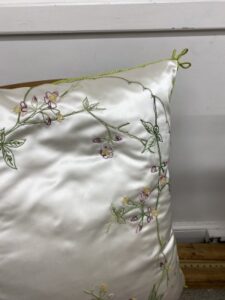
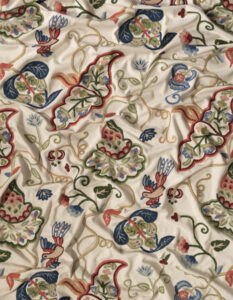
Many people choose to leave a gift in their Will to the Royal School of Needlework as a way of helping to protect and share the beautiful art of hand embroidery for future generations.

After remembering loved ones, even a small legacy can make a meaningful difference to our work in teaching, conservation and keeping these remarkable skills alive. Some supporters also choose to make a gift in memory of someone special, creating a lasting tribute that celebrates their life while helping this extraordinary heritage continue to flourish.

Your support, in whatever way feels right for you, would mean a great deal to us. For more details, please contact [email protected].

We see many family pieces come into the RSN Embroidery Studio for conservation or restoration, and they all arrive with treasured memories. Several years ago, a client approached us with a beautiful cushion originally embroidered by her grandmother. The grandmother had been an accomplished embroiderer, and the client wanted to preserve her work. Although the embroidery itself was still complete, the background fabric had deteriorated and become extremely fragile, making the cushion unusable.

During our discussions, the client explained that her niece would love to recreate the embroidery, despite having very little experience. We worked with them to redraw the design from the original cushion, gently refining the lines, as tracing directly from embroidery can often create a slight wobble in the drawn line. The design was then transferred onto new silk using the prick-and-pounce method, followed by painting in the lines.

We carefully matched the threads to the colours on the original cushion, working across both the Anchor and DMC ranges to achieve the closest possible match. The fabric was then mounted into a slate frame, ready for stitching.

The client’s niece came to the studio for a lesson to help her get started, and she took to the stitches remarkably well. The project took some time to complete, and a couple of months ago the finished embroidery was brought back to us. She had worked it beautifully and clearly enjoyed the process, something we believe is the most important part of any project.

It was wonderful to see the finished piece, and she has certainly inherited her grandmother’s embroidery skills. Our client had the embroidery made into a cushion, matching the backing fabric and cord as closely as possible to the original, and planned to present it to her niece as a surprise.

The original cushion has now been carefully packed for storage in conservation tissue and a protective box.

Do you have a you have a treasured family piece that you would like restored or conserved?

Get in touch with the RSN Embroidery Studio Team or visit the website today for bespoke embroidery commissions, restoration and conservation services.

Give your mother or loved one the gift of embroidery this Mother’s Day and treat them to a special day class with the RSN. From Saturday 14 March 9am – Monday 16 March at 5pm, each of our beautiful Day Classes are available for 50% off when booking 2 or more classes, making it the perfect opportunity to enjoy a creative day together or give a thoughtful and memorable gift.

This limited-time offer applies to our Day & Evening Classes, both Online and at Hampton Court Palace. Please note that RSN Experience classes and Technical Tuesdays are excluded from this promotion.

See our full list of Day Classes here

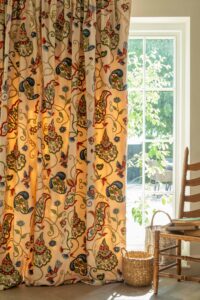
We are delighted to introduce ‘Janwardar’, the result of a collaboration between the Royal School of Needlework Archive and Welland & Wye, a boutique producer of crewelwork fabric for interiors.

“I approached the RSN to see if we could work together,” explains Frances Barber, founder of Welland & Wye. “It was a long-held goal of mine to find a beautiful archival piece and resurrect it for use as material for soft furnishings.”

Projects like this demonstrate how historic needlework can inspire contemporary interiors while supporting skilled hand embroidery, and the RSN was delighted to forge a new partnership.

Working closely with Anne Butcher (Head of Studio and Standards), the RSN Embroidery Studio team created a new design inspired by an archival document attributed to an artist known simply as ‘Schneider’.

The final pattern was embroidered in Kashmir, India, by a family team of artisans with whom Frances’ family has worked for over twenty years.

“The embroidery wool and cotton backcloth are dyed by hand. The embroiderers work on the fabric in the winter months, when their farm animals are brought into the villages to shelter from the harsh Himalayan climate,” explains Frances.

Using an ‘aari’ needle, the team of embroiderers work on bolts of fabric to create a beautifully naturalistic cloth that is highly sought after by interior designers and homemakers alike.

Anne remembers, “One of our biggest challenges was adapting from the fine embroidery that we do in the Studio to the larger canvas of this fabric. We needed to simplify the design and use just one stitch that could be created using the aari.”

The resulting fabric, Janwardar (pronounced JAN-war-dar), means ‘bird design’. It is a joyful, colourful pattern, ideal for curtains, blinds, cushions and upholstery across the home.

This collaboration highlights the RSN Archive’s role as a living resource, inspiring contemporary design while preserving historic needlework traditions. RSN members may be particularly interested in seeing how archival designs can be translated into large-scale textile production.

To see Anne and Frances discussing the creation of Janwardar, click here.

Shop ‘Janwardar’ fabric here

The RSN Embroidery Studio team particularly enjoy working on pieces that hold a deep personal connection for their owners, especially when that connection spans generations. Often, we never meet the future custodians of these objects, but in this commission, we were fortunate enough to do so.

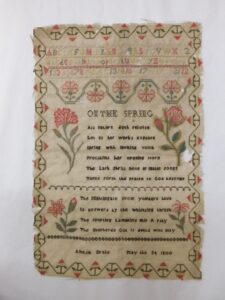
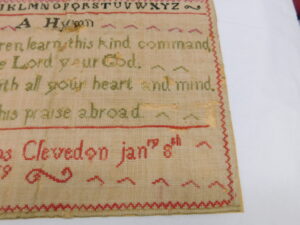
These samplers were worked by the client’s many-times-great-grandmothers: one by Amelia Drake, dated 1800, and the other by Sarah Clevedon, dated 1819. Both pieces were framed and showed evidence of historic moth damage. However, upon removing the frame backs and samplers, no active pests were found.

Both samplers needed to be removed from their frames and wooden stretchers prior to cleaning, allowing for the careful removal of surface dust, ingrained dirt, and insect residue. When embroideries were originally mounted onto wooden stretchers, they were often secured with nails which, over time, can rust and deteriorate the surrounding fabric.

Additionally, the samplers lacked full support across their entire surfaces, being held only at the edges. This left the fabric vulnerable to insect access and allowed the weight of the embroidery to place strain on the fibres, causing gradual distortion over time.

Wooden stretchers can also contribute to colour change within a sampler for several reasons: they may trap dust and dirt against the textile, or the wood itself may cause discolouration where no protective fabric layer is present between the stretcher and the embroidery.

The samplers were fully supported and secured before being mounted onto fabric-covered, conservation-grade board, ready for placement into new frames. Areas of damage were stabilised to prevent further deterioration in weakened sections.

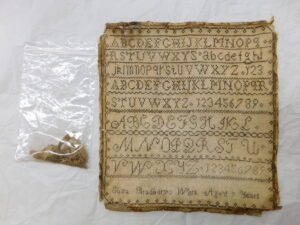
In addition to these two samplers, the client also owned a third sampler worked by a different ancestor, Eliza Bradbury, who was only seven years old when she completed her piece. The client is currently researching Eliza and working to add her to their family tree. All three samplers underwent a similar conservation process prior to reframing, which will help extend their lives, provided they are displayed out of direct sunlight and in a stable, even temperature.

Upon completion, the conserved samplers were collected by the client’s son and grandson, both of whom were fascinated by the conservation process and looking forward to becoming their future custodians.


Do you have an object you would like made, restored, or conserved?

Why not get in touch with the RSN Embroidery Studio Team or visit the website today for bespoke embroidery commissions, restoration and conservation services.

Read more stories from the RSN Embroidery Studio

‘Hand Embroidery: Skills and Studies’ is an e-certificated sampler-based course exploring, learning and developing stitch and embroidery techniques, whilst studying and researching traditional, historical and contemporary embroideries and textiles.

The course combines several techniques and subjects in module form, including knots, grids, couching, shading, canvas and purls, with the course expanding in future to include more modules. The course is now being offered onsite at RSN Durham, Hampton Court Palace and RSN Bristol, as well as Online throughout the year.


RSN Hand Embroidery: Skills & Studies Taster Days

Following the success of the ‘Hand Embroidery: Skills and Studies’ course at RSN Durham and Online, we are pleased to offer taster days for the course at Hampton Court Palace and at RSN Bristol. During the day, students will have the opportunity to stitch four sampler squares each exploring a key embroidery technique which will give them a taste of what is offered on the full course. Students will explore bullion and French knots using different colours and fibres to create texture and impact, build trellis patterns in surface embroidery and learn traditional couching including curves and turns.


Online Information session:

Online – Thursday 12th February 2026 at 7pm UK local time.

Please click here to register


Taster session dates:

Hampton Court Palace – 27 February & 27 March

RSN Bristol – 28 February & 28 March

Please click here to book your taster day


Upcoming module dates:

RSN Durham – with RSN Tutor Tracy Franklin: 10am – 4pm

Grids Module – 27 February, 20 March, 8 May, 29 May, 19 June and 3 July 2026.  (3 spaces remaining)

Knots (intensive course) – April 2026: Tuesday 21, Wednesday 22, Friday 24, Saturday 25, Tuesday 28, Wednesday 29. (4 spaces remaining)


Hampton Court Palace – with RSN Tutor Zina Kazban: 10am to 4pm

Knots Module – 24 April, 15 May, 12 June, 10 July, 21 July, 21 August 2026 (10 spaces remaining)

Grids Module – (New dates coming soon)


RSN Bristol – with RSN Tutor Amanda Rymel (grids): 10am to 4pm

Grids – 19 April, 17 May, 31 May, 14 June, 28 June, 26 June 2026 (7 spaces remaining)

Knots – (New dates coming soon)


Find out more about the RSN Skills and Studies course, and book a taster session here

See everything happening at the RSN this month!


Day Classes

Learn to Draw for Embroiderers 2 – Get Confident with Using Colour (European Time) – Online, Wednesday 11 February

Introduction to Blackwork Shading – Hampton Court Palace, Saturday 21 February

Embroidered Spring Flower Cards – Hampton Court Palace, Saturday 28 February


Experience Classes

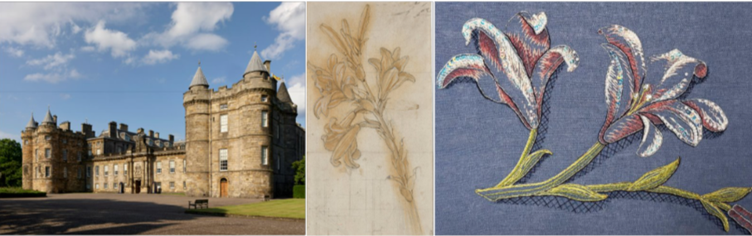
Embroidered Lily inspired by ‘Drawing the Italian Renaissance’ exhibition at the Palace of Holyroodhouse – Exclusive RSN Experience Class – Sunday 22 February – 4 SPACES LEFT


Online Talks

Stitching in the City: A History of Lace in New York – With Lace and Textile Historian, Elena Kanagy-Loux, Wednesday 11 February, 7pm GMT

The Litany of Loreto and the History of Embroidery – With former RSN Chief Executive, Dr Susan Kay-Williams, Wednesday 18 February, 7pm GMT


Open Days

Certificate & Diploma Online Information Session – Online, Tuesday 10 February, 9am GMT

Degree Open Day, Hampton Court Palace, Wednesday 4 February 2026

Degree Open Day, Hampton Court Palace, Wednesday 25 February 2026


Dates for your Diary

Pride History Month Live Online Talk: Queer Crafts: Material Practices and the Making of Identity – Wednesday 11 March, 7pm GMT


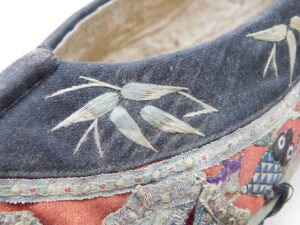
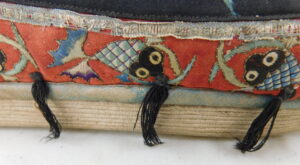
in 2025, a client brought to us for cleaning and repair the most delightful pair of Chinese shoes, embroidered with fish in the finest floss silk thread. They had discovered them on a flea market stall and had proudly displayed them in their home ever since.

The shoes are made from cotton fabric, with silk embroidery decorating the sides, and were clearly constructed by hand. At the front of each shoe were several three-dimensional elements, though on arrival it was difficult to discern what these pieces were meant to represent, as they had become badly crumpled over time.

The shoes were carefully cleaned and humidified, with loose threads secured. Tiny tassels were steamed so they could lie flat once more. Despite the delicacy of the silk embroidery, it was fortunately in very good condition. Creases and the three-dimensional elements were slowly eased back into shape using controlled humidity and the tiniest of irons. All this work revealed that these sculptural details formed the head of a fish. Once restored to their intended shape, the shoes took on an entirely different look and feel.

Although the shoes show some signs of wear, we believe this is largely due to handling and admiration rather than use. The creasing to the three-dimensional fish at the front was most likely caused by long-term storage. Now fully restored, the goldfish shoes are to be mounted in a box frame, where they will be protected, but thoroughly appreciated.

After collection, we received the following email from the client, which we truly value and shared with those who carried out the work:

“I am thrilled with the Goldfish Shoes. Thank you so much. They look incredible, I hadn’t really appreciated all the details. I love the way you can now see the individual characters of the fish, quite charming. I felt quite emotional when I saw them this morning. I will fully look after them… no more being propped on the mantelpiece.”

Do you have an object you would like made, restored, or conserved?

Why not get in touch with the RSN Embroidery Studio Team or visit the website today for bespoke embroidery commissions, restoration and conservation services.

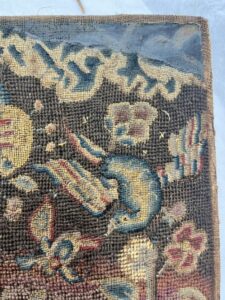
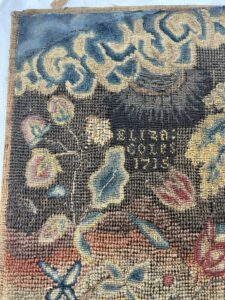
At the RSN Embroidery Studio, we are entrusted with many pieces of embroidery that hold deep family significance, but this particular piece is one of the oldest works that has remained within the same family from it’s creation. This canvaswork embroidery was stitched by the client’s ancestor in 1715 and has been kept within the family for over 300 years.

The family researched the embroiderer extensively and knew a great deal about her life, making her presence feel very close, not only to them, but to us as well. This knowledge brought with it a strong sense of responsibility to ensure that this treasured embroidery is cared for, for future generations of the family.

The piece has clearly been loved and valued throughout its life. The client remembers her grandparents having it reframed to protect it while still allowing it to be enjoyed. Considering its great age, it remains in very good condition, with no holes or broken threads.

It appears that the embroidery may originally have been made for a different type of frame, possibly a small firescreen with a curved top. This is suggested by the small areas of plain canvas at the top corners, which have been carefully painted in a colour matching the stitched background to disguise the absence of stitches. While the painting works visually with the square corners of the current rectangular frame, it hints at an earlier form. It is not clear when this alteration was made, but it forms part of the embroidery’s biography, one chapter among many in its long life.

We are very fortunate to work with Dr Isabella Rosner, the RSN’s Curator of Textiles, and we occasionally ask her to examine clients’ pieces to see if she can add historical context. Isabella had the following to say about this embroidery:

“The embroidery is wonderfully typical of the time. In the early 18th century, it was common for girls nearing the end of their embroidery education to make canvaswork firescreens, chair backs, seat covers, and similar furnishings. The original curved top of this piece suggests it began life as a firescreen.

The design takes inspiration from exotic imagery, seen in the craggy rocks, the bird with outstretched wings in the top right corner, and the palm tree beneath which the central figure stands. I’m especially interested in the sunflower to the right of the figure, as this style of sunflower appears more often in American canvaswork than British, making it a relatively rare inclusion here.

The fact that the maker stitched her name and the date is also quite unusual, as most canvaswork pieces of this type are unsigned and undated. Overall, it is a really lovely example of early 18th-century domestic embroidery.”

But the story does not end there.

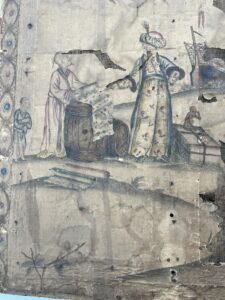
When we removed the embroidery from its frame, we discovered an exciting and unexpected find: a fragment of wallpaper attached to the wooden board behind the embroidery. Isabella immediately recognised its potential significance. With the client’s permission, she shared an image with an associate, an Assistant Curator of China at a London museum.

They had not encountered a piece quite like it before and felt it was particularly significant, especially as it depicts a trade figure, possibly linking it to the Chinese–British silk trade of the 18th century. Notably, whoever reframed the embroidery in the past, perhaps more than once over its 300-year history, had clearly felt the wallpaper was important enough to keep with the piece.

Originally attached directly to the mounting board, the wallpaper raises intriguing questions. Was this a deliberate act of preservation, or an example of reuse and repurposing? Like the embroidery itself, it adds another layer to the object’s rich and evolving story.

Do you have an object you would like made, restored, or conserved?

Why not get in touch with the RSN Embroidery Studio Team or visit the website today for bespoke embroidery commissions, restoration and conservation services.

We all have unfinished embroideries tucked away in boxes and cupboards – well-intentioned pieces begun as gifts or to mark a momentous occasion. Sometimes, however, an upcoming event prompts us to revisit these works, either to complete them at last, or to seek help in doing so.

One such client came to us with exactly this hope: to finish an embroidery piece she had begun whilst pregnant with her daughter, and to present it as a gift for her daughter’s 50th birthday.

“I left my teaching position in December at the end of term. After about 16 weeks of pregnancy, my sickness began to ease, and I thought it would be good to have a project to work on. I saw the Spring Flowers crewel embroidery advertised as a kit in Family Circle magazine. I loved the image of the completed piece and decided to send away for it.

I hadn’t paid much attention to the dimensions, so when it arrived I was astonished by its size — 18 x 40 inches (45.7 x 101.6 cm)! In the end, I decided to finish only half of it, which is what you see framed today. But in 1975, at 25 years old, happily married for six months, and full of confidence after two years of teaching, I thought: never mind the size, I have plenty of time.

By the time my daughter was born in August 1975, I had at least made a start. I soon learned, however, that a new baby takes up all your time, and any free moments you think you might have! The years that followed brought two more children, several pets, and a very busy life, meaning the piece rarely saw the light of day.

I did manage small amounts when I could, and eventually I took the embroidery to a daytime sewing group at the Needlecraft Centre in Thame. There I received expert advice, encouragement, and support, and began working the large, bright flowers in the foreground. After discussing it with the needlework teacher, I decided to make the project more manageable by finishing it halfway, a very good decision.

My neurological health condition later made extended stitching difficult. The final attempt I made was in 2024, when I completed a little more of the grasses and French knots, but Parkinson’s tremors and pain made it impossible to continue. With only a tiny section left unfinished, I had to accept that I could not complete it myself.

I began looking for advice on whether it was possible and worthwhile to finish the embroidery. That’s when I found the RSN online. I read that alongside prestigious commissions, such as King Charles and Queen Camilla’s coronation robes, they also restore and complete unfinished projects. I rang the studio and left a message…”

This is where we took up the story…

We worked closely with our client to complete the remaining section of the embroidery, ensuring that our stitching blended seamlessly with her own beautiful work. For someone with such a busy life, the embroidery had been executed with great care and skill. Thankfully, she had kept all the original materials together, allowing us to use the correct wools and follow the original kit instructions precisely.

Once the embroidery was complete, we mounted it onto fabric-covered, conservation-grade board in preparation for framing. The client and her husband collected the finished piece and took it to our recommended framer, who worked with them to select a frame that would truly enhance the embroidery.

The result is a deeply meaningful and beautiful gift, carrying with it a remarkable story spanning five decades.

Do you have an object you would like made, restored, or conserved?

Why not get in touch with the RSN Embroidery Studio Team or visit the website today for bespoke embroidery commissions, restoration and conservation services.

As we begin the new year, let’s leave winter behind and achieve that New Year goal for trying something new.

2026 has already brought many things, including New Year’s resolutions, and some brand-new classes to RSN!

Drift away from winter and celebrate spring by joining one of our floral embroidery courses. These include Tutor Natalie Rowe’s Native Wildflower class or Tutor Sue Kim’s Embroidered Spring Flower Cards. Both take place at our magnificent home of Hampton Court Palace, where you can enjoy a day of craftmanship and finish with a visit to our lovely Shop to pick up a keepsake to remember the day.

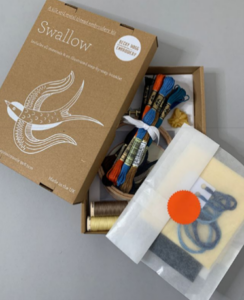
Perhaps you’re not quite ready to let go of the cosy duvet days that winter brings just yet. If so, why not try one of our online classes  from the comfort of your own home? Including Tutor Caroline Homfray’s “Learning to Draw for Embroiderers” Courses one and two which can be taken in any order and are ideal for building confidence at your own pace. Or join Tutor Becky Hogg’s Goldwork class, which will guide you through the creation of a beautiful Metalwork Swallow that you can keep for yourself or gift to a loved one.

And that’s not all!

If you’re looking for a real treat, our Experience Classes offer a full day of embroidery heaven in settings that celebrate history, art, and craftsmanship. Embroider a Lily inspired by ‘Drawing the Italian Renaissance’ exhibition at the Palace of Holyroodhouse in Edinburgh with Tutor Helen McCook or visit Canterbury Cathedral to learn the art of Appliqué using the design of The Dove of Peace and Huguenot Chapel with Tutor Helen Stevens.

No matter how you choose to spend your new year, either venturing out or staying local, it is the perfect time to continue a long-held passion or begin a new one. Surround yourself with others who share a love for embroidery and the joy of making by booking a class today!

Browse the full list of Day & Evening classes here.