Join the RSN this month for Day & Evening Classes, Experience Classes, Info sessions and more!


Online Day & Evening Classes

Learn to Draw for Embroiderers 2: Get Confident with Using Colour: Wednesday 2 April

Introduction to Broderie Anglaise and Richelieu; ‘Starfish’: Weekly, from Monday 7 April – Monday 19 June

Introduction to Box Making: ‘Nigella Initial Box’: Weekly, from Wednesday 9 April – Wednesday 30 April

Designing for Jacobean Crewelwork: Tuesday 22 April

Learn to Draw for Embroiderers 3: How To Create Your Own Beautiful Designs: Wednesday 23 April

RSN Embroidery Studio Kits: ‘Jacobean Crewelwork Inspired by the RSN Design Room’: Wednesday 23 April

Intermediate Stumpwork: ‘Green Fire Bird’: Weekly, from Thursday 24 April – Thursday 8 May

Introduction to Embroidery: ‘The Beginning’: Weekly, from Wednesday 30 April – Wednesday 7 May


Onsite Classes at Hampton Court Palace

Blackwork Medieval Floor Tiles: Saturday 5 April

Introduction to Embroidery: ‘Stylised Flower Sampler’: Saturday 5 & Sunday 6 April

Silk Shaded Daisy Inspired by The D-Day Story: Saturday 26 April

Experimental Embroidery: Saturday 26 April


RSN Experience Classes

‘Teatime’ inspired by the Collection at Arundells, Salisbury: RSN Experience Class, Saturday 5 April


Events & Exhibitions

‘Tales of Textiles: The RSN Collection in Focus’: Hampton Court Palace, on set days until June. Prebooking essential, last few spaces available. Closing Soon.


Online Certificate & Diploma Info Session to learn more about the Course

Wednesday 30 April 2025, 2:00pm (UK Time)


This month, RSN Stitch Bank reaches a huge milestone: the launch of its 500th stitch! To celebrate this invaluable free resource, used by stitchers across the globe for inspiration, education, and preservation, we’re adding 25 new stitches on Friday 21 March, each named after places around the world.

These new additions are stitches with geographical connections such as Surrey stitch, created by a member of a Surrey branch of the Women’s Institute, while others reflect the cultural heritage of traditional embroidery styles, like Hungarian braided chain stitch. Some carry an air of mystery, with origins less certain but names steeped in history, like the timeless old Florentine stitch. No matter their origin, each stitch tells a unique story, adding to the rich tapestry of global embroidery traditions.

Mark your calendars to explore the new additions and celebrate this remarkable achievement with us! In the meantime, you can browse the existing 475 stitches here.


Join in the celebration

To mark the occasion, we have created two lovely free templates for you to stitch. Email a picture of your finished work by Monday 17 March to [email protected] to have your work featured on our Instagram and Facebook pages!

Download our star template

Download our flower template


Support RSN Stitch Bank

RSN Stitch Bank is a free resource, that relies on the generous donations of its user to keep it growing and help preserve stitches for future generations to come.

RSN Stitch Bank has been made possible thanks to a number of charitable trusts and many individual donors who have ‘Adopted a Stitch’ for themselves, a friend, group, or loved one. If you would like to support the project and ‘Adopt a Stitch’, find out more here.

Visit RSN Stitch Bank here

Donate to RSN Stitch Bank here

This month, as the days become longer in the northern hemisphere with more natural light to embroider, the RSN starts to venture out to events, sharing our students’ stunning work with the world.

Fashion & Embroidery, NEC Birmingham

We begin our journey at the ‘Fashion & Embroidery’ exhibition at the NEC Birmingham from 13 to 16 March.  The hand embroidery on display will be full of pops of red alongside the world-famous Red Dress, conceived by British artist Kirstie Macleod.  We will also run a 90mins ‘International Stitches to Inspire’ workshop every day, inspired by a 20th century suzani from the RSN Collection and the amazing Red Dress. For a 30% discount code, read the full story here.


The Stitch Festival, Business Design Centre

On return from the NEC, the RSN will teach a ‘Colourful Peacock’ 90mins workshop every day at ‘The Stitch Festival’, Business Design Centre, London, 20 to 23 March. The Stitch Festival is the best event in London for contemporary dressmaking, sewing and stitch, where you can meet independent brands and small businesses, alongside catwalk shows and demos. The RSN has received a discount code from the show organisers. Enter code ‘RSN25’ at checkout for a £2 discount. We will also be running a competition to win a pair of tickets through Instagram, so make sure to follow us to enter!


Save the Dates

And that’s not all…over the next couple of months, there are more event dates to save in your diary, where you’ll be able to view wonderful work by RSN students and Tutors, or join us for a workshop:


‘Feel Good Festival’, 16 to 18 May, Hampton Court Palace.  Every day of the event, we will teach a 90mins ‘taster’ workshop of the ‘Colourful Peacock’, during Mental Health Awareness Week, introducing the art of hand embroidery to a new community.

To book an RSN workshop during the Feel Good Festival, choose the day you wish to attend below:


Hand Stitched Heritage’, 16 May to 13 June, Royal West of England Academy (RWA), Bristol.  This exhibition will showcase the work of RSN Apprentice and Future Tutor Alumni, and will run alongside ‘Soft Power lives through Textile Art’ curated by Textile Artist Prof. Alice Kettle, and Prof. Lesley Millar MBE.

From RSN Apprentice to Tutor, learn more about the wonderful, diverse career journey of RSN Tutor and Fellow, Emma Broughton:

“Hi, I’m Emma Broughton, an embroidery artist, RSN Fellow, and Tutor. My passion for embroidery began during a summer lesson at secondary school with RSN Tutor Shelly Cox. That one lesson sparked a love for the craft, leading me to apply for the RSN Apprenticeship program, where I was lucky enough to train and work on incredible projects.

During my Apprenticeship, I worked on a garment for London Fashion Week with Hussain Chalayan, helped the RSN Embroidery Studio team to recreate a watercolour by Basil Alkazzi (his signed print still hangs in my studio), and even designed a tapestry kit for the then-Mayor of London’s wife to stitch the Mayoral Crest into a cushion. I later expanded my knowledge with a Textiles degree at UCA Farnham, which re-shaped my approach to embroidery by using self-designed fabrics—something I first introduced in my Mushroom Box class and plan to develop further with hand dyed fabrics.

One of my proudest achievements was writing and photographing all the boxes for my book, Embroidered Boxes, published by Crowood Press in 2019. Becoming an RSN Tutor, and last year an RSN Fellow, has allowed me to share my love of embroidery not just as a craft but as a form of storytelling. My goal as a Tutor is to make embroidery accessible, inclusive, and filled with creative possibilities. My class designs are mostly drawn from natural forms or from architectural elements near my studio on the outskirts of Salisbury, Wiltshire.

More recently, I was honoured to receive a Developing Your Creative Practice grant from Arts Council England, with the invaluable support of RSN’s previous Chief Executive, Dr. Susan Kay-Williams. This grant gave me the space to rediscover myself as an artist after navigating the loneliness of early motherhood all while dealing with losing my mother within a very short time. It was in this space that my Blackwork portrait project truly took shape; a way to reclaim my artistic voice and tell stories that resonate deeply with me. I realise that my work, starting in my Apprenticeship days, has always taken on a personal form of storytelling in one way or another.

This project was also a second chance to create a portrait that truly reflects who I am today, replacing my Apprenticeship piece. ‘May Day’, is the first in this new series, inspired by a powerful scene from The Handmaid’s Tale, reflecting resilience, advocacy, and the fight for women’s rights. Drawing from Margaret Atwood’s original novel, I’ve woven subtle details into the piece—including a twist on the phrase “Blessed be the fruit”. The stark contrast of black and white with pops of colour is a deliberate choice to challenge portraiture conventions and provoke thought.

I’m thrilled that May Day will be on display at the exhibition ‘Hand Stitched Heritage, at RWA Bristol from 17 May to 13 June 2025.”

Explore the list of Emma’s upcoming Day Classes here

Find out how to become an RSN Tutor

The RSN Certificate & Diploma in Technical Hand Embroidery Course is an excellent and flexible way to elevate your hand embroidery skills and can be learnt from wherever you are in the world!

Meet Phoebe, who shares with us her experience of learning through Certificate & Diploma Intensives:

“I started dressmaking when I was 12 and went on to study Art and Textiles at GCSE and A -level, followed by a BA (Hons) in Costume Design and Construction at Nottingham Trent University (NTU). During lockdown I began to study history and fashion and developed a particular interest in historical costume and the various techniques used to create often elaborate and complicated garments. Whilst at NTU, I studied a millinery module; my final piece was a 1940s-style felt hat, decorated with embroidery, and it was then that my fascination with the technique was kindled.

One of my Tutors suggested I pursue the Certificate programme at the Royal School of Needlework. I took one of the self-paced Online classes and really enjoyed it, so from there I looked at the Certificate and Diploma courses and decided to study the Certificate as an intensive summer course at Hampton Court Palace in the time between my second and final degree years.

I find I learn more effectively from condensed blocks of learning so enjoy the fast-paced style of the intensive classes. I learnt so much during that summer Certificate course that I decided to specialise in the discipline during my final year university projects. This led to me recreating a heavily-decorated costume worn by Lord Byron for members of the public to try on at his ancestral home of Newstead Abbey, and making a flamboyant ballgown with an embroidered bodice for a character from the novel The Selection.

Having graduated from university, I am currently completing the intensive RSN Diploma. I have really enjoyed discovering the stitching process of the six different techniques and feel proud of the high level of the work I have produced. Every RSN Tutor has a unique way of approaching their subject and it is fascinating to work with them and learn the various ways of solving problems and creating often complex images. To date, my favourite pieces have been Advanced Goldwork and Advanced Silk Shading as they have really allowed me to demonstrate my skills to the best of my abilities. For Silk Shading I chose to stitch my tabby cat – a somewhat daunting challenge because of all the detail needed to depict his facial features and multi-coloured fur, but I was delighted with the end results. My Goldwork heart* was a pleasure to create; I love the use of different metals and paddings to create the beautiful, multi-dimensional textures.

My time at RSN has been both fulfilling and wonderfully enjoyable. I have made a number of lifelong friends with a shared love of embroidery and above all have learnt so much, not just from the Tutors and from stitching my own projects, but from observing the work of my fellow students. I am very much hoping that my future career will allow me to further develop my love of embroidery in all its forms.”


Inspired by Phoebe’s words?

See Phoebe’s Goldwork Heart at ‘Fashion & Embroidery’ at the NEC, Birmingham, this month!

Join our next Certificate & Diploma Online Info Session to get your hand embroidery journey started.

Certificate & Diploma 2025 Intensives Dates

Join the RSN in March for beautiful embroidery exhibition, Online Talks, Day Classes and more!


Online Day & Evening Classes

Learn to Draw for Embroiderers 3: How To Create Your Own Beautiful Designs: Wednesday 5 March – only 3 places left

Introduction to Long & Short: ‘Spring Leaf’: Weekly, from Thursday 6 March to Thursday 10 April

The Lewis Chessman Flower: Weekly, from Monday 10 – Monday 24 March

Introduction to Embroidery: ‘Spring Flowers’: Weekly, from Thursday 13 March – Thursday 20 March

Mounting Your Finished Embroidery: Saturday 15 & Saturday 22 March

Intermediate Stumpwork: ‘Green Fire Bird’: Weekly, from Tuesday 18 March – Tuesday 8 April

Pattern Darning: ‘Colour Band Sampler’: Saturday 22 March

Visible Mending: Weekly, from Wednesday 26 March – Wednesday 9 April

Gold and Blackwork Butterflies: Weekly, Sunday 3 March – Sunday 6 April


Onsite Classes

Introduction to Canvaswork: Inspired by Mondrian: Hampton Court Palace, Saturday 8 March – only 2 places left

Native Wildflower: Arrowhead: Hampton Court Palace, Saturday 8 March

Birch Tree in Sunlight: Hampton Court Palace, Sunday 16 March

Petali: An Introduction to Reticello Embroidery: Hampton Court Palace, Saturday 22 March

Whitework and Goldwork Flowers: Hampton Court Palace, Saturday 29 & Sunday 20 March

Gold and Blackwork Butterflies: Hampton Court Palace, Saturday 29 March


RSN Experience Classes

17th Century Silk Flora inspired by Tales of Textiles exhibition, Hampton Court Palace, Wednesday 19 March – only 2 places left


Events & Exhibitions

‘Tales of Textiles: The RSN Collection in Focus’: Hampton Court Palace, on set days until June. Prebooking essential.

Fashion & Embroidery Exhibition, NEC, Birmingham, including 90-minute workshops, 13 – 16 March

The Stitch Festival, Business Design Centre, London, 90-minute workshops, 20 – 23 March


Online Talks

Exploring 17th Century objects as Makers and Researchers: with RSN Curator of Textiles Dr Isabella Rosner and RSN Studio embroiderer Marg Dier, Wednesday 12 March, 7pm GMT

May Morris, Arts & Crafts Designer-maker, with Needlework Historian, Dr Lynn Hulse, Wednesday 26 March, 7pm GMT


Online Certificate & Diploma Info Sessions

Tuesday 4 March, 9:00am GMT

Combining art and advocacy, the Royal School of Needlework is championing biodiversity, using needle and thread to craft powerful messages about the importance of protecting the natural world. ‘Fragile Threads’, is an innovative and collaborative partnership programme made possible thanks to a £247,000 grant from The National Lottery Heritage Fund and aims to spotlight endangered species, celebrate ecosystems, raising awareness and inspiring action to preserve the planet’s extraordinary biological diversity.

Embroidery is an art form celebrated for its intricate beauty and throughout history has served as a dynamic medium for environmental storytelling. Unique and rich embroidery traditions have used stitching to record events, impart knowledge, and make powerful statements. Fragile Threads places creative self-expression and the fragility of the natural world side by side. Embroiderers have always looked to the natural world for inspiration, and their artwork has recorded the movement of species around the world, mapping their importance to global social and economic networks. However, 37% of species in the UK have experienced population decline over the past 50 years (Source: State of Nature Partnership 2023) , and globally one million species are thought to be at risk*.

Fragile Threads has enabled us to collaborate with conservation groups, educational and art establishments and invite their communities to contribute their stitches to biodiversity-themed projects. A series of projects will teach participants new skills and help them better understand the fragility of their natural surroundings by embroidering their own biodiversity stories.

Rhian Harris, Chief Executive of the Royal School of Needlework said:

“For centuries, the art of hand embroidery has been inspired by nature and has been a powerful platform for self-expression. Through Fragile Threads we aim to amplify awareness of critical ecological issues, including habitat loss, climate change and species extinction. We are thrilled to have the support of The National Lottery Heritage Fund, and it is thanks to National Lottery players that we can bring this project to life and help promote both the art of hand embroidery and the urgent need to address biodiversity loss.”

Partnerships with a number of visionary organisations include :

  • Action for Conservation – a bespoke embroidery project to explore the importance of sustainable textiles; traditional craft; consumerism and fashion; biodiversity and activism.
  • Hope For Home – working with socially isolated carers of advanced dementia patients to create simple nature-inspired embroidery piece.
  • Global Generation – a series of workshops interpreting nature-based solutions through sustainable hand-stitching.
  • Intoart – teaching artists with learning disabilities to create nature-based themed pieces, exploring sustainable materials, natural dyes and embroidery techniques.
  • QEST – supporting QEST scholars to research and develop a single nature-based narrative through embroidery, working in diverse, non-textile mediums using sustainable materials.
  • Around the World in 80 Fabrics – developing and understanding knowledge about the significance of plant, animal, bio-based and recycled materials, communities and craftspeople.

As part of the initiative, we will also host a symposium and an exhibition towards the end of the programme. Additional projects and events will be weaved into our existing Educational Programme, including the BA Honours Degree in Hand Embroidery taught at Hampton Court Palace, and short courses for leisure stitching.

*Intergovernmental Science-Policy Platform on Biodiversity and Ecosystems (IPBES) 2019. The RSN commissioned a report on Biodiversity to support the development of Fragile Threads. It provides a comprehensive overview of the main issues impacting global biodiversity, with a particular focus on the UK, and explores their implications on human populations, ecosystems, and economies.


The National Lottery Heritage Fund – Our vision is for heritage to be valued, cared for and sustained for everyone, now and in the future. That’s why as the largest funder for the UK’s heritage we are dedicated to supporting projects that connect people and communities to heritage, as set out in our strategic plan, Heritage 2033. Heritage can be anything from the past that people value and want to pass on to future generations. We believe in the power of heritage to ignite the imagination, offer joy and inspiration, and to build pride in place and connection to the past.  Over the next 10 years, we aim to invest £3.6billion raised for good causes by National Lottery players to make a decisive difference for people, places and communities.  Heritagefund.org.uk


Fragile Threads Partners

Action For Conservation
Action For Conservation will deliver an interactive webinar and in-person event to 20 AFC Ambassadors who will learn lifelong skills including sewing and mending. They will also take part in a bespoke embroidery project to explore the impact of fashion on the natural world, and the importance of sustainable textiles and traditional craft.  actionforconservation.org

Around The World in 80 Fabrics
RSN is partnering with Around the World in 80 Fabrics, a non-profit working with global communities to champion non-petroleum fabrics—plant, animal, recycled, and bio fabricated. Through Fragile Threads, ATW80F will connect project partners with diverse fabrics, makers and biomes, highlighting the cultural and ecological stories behind biodiverse fabrics. atw80fabrics.com

Global Generation
Young people working with environmental education charity Global Generation will explore the fragility, beauty and interconnectedness of our natural environment through the medium of stitching in partnership with tutors from the Royal School of Needlework, creating a beautiful piece which will be permanently displayed in Global Generation’s new community garden in King’s Cross.  globalgeneration.org.uk

Hope For Home
Hope For Home will offer around 60 unpaid carers who look after their loved ones with dementia at home the opportunity to create simple nature-inspired embroidery pieces. These pieces will contribute to an exciting display for our final exhibition. Expert support will be provided virtually and by telephone. It is hoped that this creative needlework will contribute to the wellbeing of these carers and allow them some time for relaxation away from their caring responsibilities .  hopeforhome.org.uk

Intoart
This dynamic collaboration will provide access to embroidery knowledge to artists with learning disabilities. Together we will create nature-based themed pieces involving full-day workshops exploring sustainable materials, natural dyes, and embroidery techniques.  intoart.org.uk

QEST
QEST, a charity that funds the training and education of talented makers on their craft journeys to excellence, will engage up to 6 makers from its Alumni network, through an open-call, to research and develop a single nature-based narrative explored through embroidery, working in diverse, non-textile mediums using sustainable materials.  qest.org.uk


Images featured are Fantastical Moth by RSN Degree Graduate Eliza Gomersall; Woodland scene applique panel by RSN Embroidery Studio; Advanced silk shading of a Kingfisher by RSN Diploma Student Heather Milne
The Royal School of Needlework and Pasold Research Fund invite papers for the Royal School of Needlework’s first conference on historical needlework, ‘Stitched Together: Needlework Making and Research’.


21 -22 August 2025

Royal School of Needlework, Hampton Court Palace

Keynote speakers: Dr Lynn Hulse, Raisa Kabir, Rose Sinclair MBE, Hannah Sutherland ACR


This conference will imagine needlework in its broadest sense, classified as all art and craft involving a needle, hook, or shuttle. This includes embroidery, plain sewing, lace making, knitting, crocheting, and weaving.

Needlework is universal, made around the world in countless ways for nearly all of human history. Through needles, hooks, and shuttles, we see economic, social, political, religious, and cultural changes. Needlework demonstrates who had access to what materials, how designs and stitches travelled the world via the Silk Road and across oceans, how the rise and fall of empires affected design and resources, how technology influenced changing aesthetics and craft practices, and how people have spent their time in business and leisure.

Though needlework has long been the subject of academic, socioeconomic, and object centric study, there have been very few opportunities for those who create needlework and those who research needlework to collaborate and learn from one another. It is the hope that this conference will bridge the gap between visual and historiographical analysis and knowledge of the historical, socioeconomic, and literary contexts of needlework with embodied knowledge of materials, techniques, and artistic choices.

This conference is a meeting place for anyone working on topics related to historical embroidery to present their work and research. This includes work happening in academia, museums and heritage institutions, art studios, classrooms, and independent research environments. We encourage proposals from established and emerging scholars, makers, curators, conservators, and anyone whose work is relevant to discussions about historical needlework in any capacity.

We invite proposals for 15-minute presentations. These can take any format, such as academic papers, conversations between makers and researchers, or demonstrations. We are especially interested in presentations that explore the potential of collaboration between those who use historical needlework in different ways.


 Topics may include but are not limited to:

  • New discoveries in the field of historical needlework
  • The relationship between making and research
  • Conservation of historical needlework
  • Curating historical needlework
  • Marginalised needleworkers (race, gender, class, region, technique)
  • Historic needlework networks, especially global ones
  • Studying historical needlework through making
  • Potential for collaboration between various stakeholders in the world of historical Embroidery


Proposal deadline: Monday, 14 April 2025

Please send a paper title, abstract (maximum 250 words), and bio (maximum 50 words) to [email protected]. Decisions will be made by mid-May.


We teach all levels, from beginner to advanced, and offer a wide range of techniques to suit every stitcher.

Our Live Online Classes are ideal if you enjoy learning in more of a classroom setting.  Alternatively, if you prefer learning at your own pace, try our Online Video Courses.  We also teach onsite at the magnificent Hampton Court Palace in south west London and also at many other prestigious venues around the UK, including Canterbury Cathedral and The Drapers’ Hall in London.


Live Online Classes

We teach a series of Live Online classes in small groups via Zoom. These take place at different times to suit different time zones.

Browse all our Live Online Classes here.


Online Video Courses

Our Online Video Courses give the flexibility to learn at your own pace, anytime, anywhere.  Courses start from £55, which include video tuition and kit.

View all Online Video Courses


RSN Onsite at a stunning Venue in the UK

Make a day of it and join us for an embroidery class at the wonderful Hampton Court Palace in south west London; Arundells in Salisbury,  Canterbury Cathedral and The Drapers’ Hall in London.   We have a selection of classes for all levels.

Browse all our Onsite and Live Online classes here.

Browse all our Online Video Courses here.

If you are new to embroidery, view our recommended selection of introduction classes.  Classes for Beginners to Embroidery.


Celebrate Christening season with the RSN Embroidery Studio!

From heirloom restorations to bespoke embroidery, our expert team of studio embroiderers ensure each Christening piece can be treasured for years to come. Read on to find out more about some of the recent Christening commissions undertaken by the RSN Embroidery Studio!


Cleaning up Christening Robes

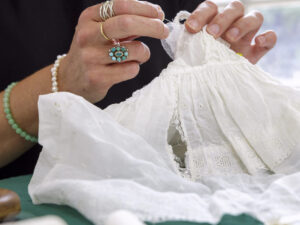
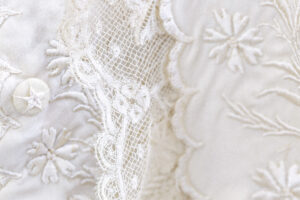
The RSN Embroidery Studio sees many family Christening robes and cloaks,  many dating from the mid-late 18th century and in beautiful Whitework techniques and the finest lace.

Cleaning Christening robes is always the first step in order to remove as many of the stains as possible. These stains often don’t show straight away, but after time the residue from the substance that causes the stain can become visible.

It is important the piece is cleaned to neutralise the stain. Once clean the robes are repaired, which includes small and large tears in areas that have the most strain. The tears can occur from wriggly babies to jewellery worn by guests. If robes are really tiny, sometimes an insert under the arms can be added,  depending on the construction of the robe. This allows for the modern baby who is larger and older than a Victorian child when christened. After the COVID restricts, some of the babies were walking and talking, giving a whole different challenge. Our Incredible Studio Team were able to come up with some solutions, each individual to the problem.


Conserving a beautiful Christening Cloak

Some families are fortunate to have not only a Christening Robe, but also a Christening Cloak, a Victorian edition to the outfit.

Earlier this year, the studio worked on the most beautiful cloak, which was a fine wool on the outside and a quilted silk lining. The woolen fabric was in good condition with no moth hole, just missing a couple of embroidered buttons. However, the silk quilted lining was deteriorating and splitting showing the wadding which in places was at risk of coming away and being lost.

To keep as much of the cloak as possible, the lining was covered with a very fine conservation net securing it throughout, therefore containing the deteriorating silk. This is not invisible, but it is discrete. Any stitching on this constructed piece was undertaken with a curved needle while the cloak was on a mannequin, as it was not possible to stitch flat on the table due to the shaping on the shoulders. Working this way also ensures that the net fits and does not distort the lining and change the shape. Finally, two new buttons were made matching the fabric and thread as near as possible to the original cloak.


A Christening Robe Inspired by Royalty

The Studio were approached by a client whose mother had, many years ago, commissioned the RSN Embroidery Studio to design and prepare the fabric for the her to embroider a christening cloak which would have been worn by our client for her own christening.

However, life became too busy and it was barely started. The fine wool fabric had gained a few too many moth holes and was not workable anymore.

The design was traced and tweaked, as the client wanted to add their own elements, then reapplied onto new fine wool fabric. The design was embroidered using a mix of stitches in a perle thread. Once embroidered, the cloak was made up with interlining and a silk lining.

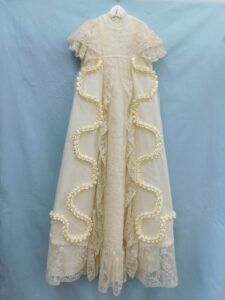
As well as the cloak, the client was inspired by a royal christening robe and commissioned the studio to create a christening robe and petticoat in a similar style, that would be worn with the new cloak. The main fabrics for these were silk, and the client had sourced antique lace to create the ruffles at the bottom of the skirts. New ribbon was purchased to produce a contrasting ruffle down the front.


Do you have a Christening object you would like made, restored or conserved?

Contact the RSN Embroidery Studio Team or visit the website today for bespoke embroidery commissions, restoration and conservation services.

UPDATE: See behind the scenes of the RSN Embroidery Studio with Viscountess Hinchingbrooke, Julie Montagu!

Spring is upon us, and for the RSN Embroidery Studio, that means wedding season!

From restoring treasured bridal heirlooms to creating something entirely new, our skilled team of studio embroiderers ensure every stitch tells a story of love, tradition, and celebration. Read on to hear more about some of the latest wedding commissions undertaken by the RSN Embroidery Studio!


One stunning veil for two sisters

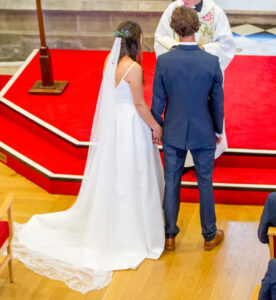
For one family, we were delighted to prepare the veil for each of their two daughters, both wishing to use the treasured veil, but each wanting to wear it in a different manner.

The veil was washed and steamed and a few tiny repairs undertaken before it was temporarily fitted to a hair comb. The combs vary in size and will be wrapped in ribbon before the veil is stitched carefully to the ribbon, protecting it from the comb. Each time, the bride to be has been to the Studio to have the comb positioned and fitted. We love this as it makes us feel part of their special day, and we always look forward to seeing pictures of the occasion.

This particular veil has been worn over many generations including grandmother, mother, aunts and cousins. The family have pulled together photos of every bride that has worn the veil and attached them to the lid of the conservation box the veil is stored in. This is a tremendous record and ensures that the information stays with the veil for generations to come.


The start of a family Heirloom

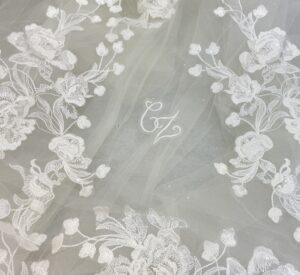
The RSN Embroidery Studio were approached by a bride who wished to personalise her new veil. The machine embroidery on the veil was such that it scooped around creating a central space into which we perfectly fitted the bride and groom’s initials.

The initials were sized and positioned to be discreet and not over whelming or overpowered by the surrounding machine embroidery. It is always tricky to transfer the design onto the net but our talented team have their special ways to do this. The letters were embroidered onto the net using padded satin stitch, giving the letters some weight, so it is readable from a distance as she walked down the aisle. The embroidery was not too heavy as this would cause distortion to the veil in the surrounding area and in time cause greater wear and tear. As this will be a future heirloom it is important that the embroidery does not jeopardise the longevity of the piece.


A Family Chinese Wedding Dress

Amongst lots of white then came the most incredible Chinese wedding dress that had been used by the customer over 30 years ago and was to be used by their future daughter-in-law.

It was to be worn for the traditional tea ceremony held prior to their wedding day. The dress consisted of a skirt and jacket and was embroidered in couched silver thread on a red silk fabric. The dragons were padded and although generally in a good condition the silk thread used to couch the silver had started to break particularly in areas of wear and tear such as under the arms and down the sides.

The red silk fabric needed some general attention and a running repair at the waistband where the skirt had parted from the band was reviewed. The team decided to remove this repair and reworked it so that it was stronger and not so visible, and then renew one of the fastenings and generally tidy the others.


Do you have a wedding object you would like made, restored or conserved?

Contact the RSN Embroidery Studio Team or visit the website today for bespoke embroidery commissions, restoration and conservation services.

This March, we are thrilled to return to the Fashion & Embroidery exhibition at the NEC, Birmingham, where visitors will immerse themselves in the world of traditional and contemporary embroidery. This year, the RSN’s stand is adjacent to the world-famous Red Dress, conceived by British artist Kirstie Macleod.

About The Red Dress

The Red Dress was created in 2009 and the RSN’s relationship with it started in 2010, when Kirstie was a Tutor on the RSN’s BA (Hons) Hand Embroidery Degree. Then, students worked on some of the original panels and we were delighted when the dress returned to the RSN in 2022 for further embroidery, and it was then exhibited for thousands to view during the RSN’s 150th anniversary exhibition at the Fashion and Textile Museum London. The Red Dress has now been embroidered on to by 380 people across 51 countries and is touring the world.

Inspired by The Red Dress, the theme of our display at Fashion & Embroidery will be the colour red, showing work by our talented Degree, Certificate & Diploma and Future Tutor students and graduates, which will be spectacular against the black walls of the stand. Visitors will be able to explore a stunning showcase of hand-embroidered pieces, from traditional to bold, modern interpretations of classic techniques.

Join one of our Workshops

Anne Butcher, RSN Head of Studio & Standards, will be teaching a 90mins workshop every day entitled ‘International Stitches to Inspire’. Anne has created a motif inspired by a 20th century suzani from the RSN Collection and the amazing Red Dress.  A suzani is a decorative, embroidered tribal textile that originated with nomadic tribes in Central Asia, and the word ‘suzani’ comes from the Persian word suzan, which means ‘needle’.

Anne has incorporated international stitches which are often used together, Bokhara couching, originating from northern Germany, and Romanian couching, widely used in Central Europe. The design is edged with Chain Stitch, a versatile stitch used all over the world, originating to 14th century BC, Egypt. The stitches all come together on the red shot silk to result in a vibrant motif. Whether you’re a beginner or an experienced stitcher, these workshops provide a rare chance to learn from an expert RSN Tutor in a supportive and inspiring environment.

Visit our Stand

Visit us on stand H30 for a truly immersive experience, discover new embroidery techniques, and leave feeling inspired! We invite visitors to sit alongside our volunteer students to practice hand embroidery on our large frame, which is always a highlight on the RSN’s stand and really brings like-minded enthusiasts together who are exploring all that the world of embroidery has to offer.

Fashion & Embroidery will take place at the same time as The Creative Craft Show and Sewing For Pleasure and entry tickets give you access to all shows.  The RSN has received a discount code for all visitors when you use CRAFTSSEW30 at checkout.

Volunteers for The Red Dress Stand

Kirstie will be on The Red Dress stand every morning from 9.30am to 1pm and the Fashion & Embroidery team are looking for volunteers to be on the stand in the afternoon, from 1pm to 5pm (4.30pm on Sunday).  Please email Jane Bolsover with your availability before midday on Sunday 9 February. Volunteers will receive up to £30 for their travel and up to £10 for their food, on return of their receipts, as well as an exhibitor pass giving them free access to visit the show in the morning, and any other day of the show.


Register now to visit the Fashion & Embroidery exhibition:  https://www.creativecraftshow.co.uk/fashion-embroidery/

Book the RSN workshop:  https://www.creativecraftshow.co.uk/fashion-and-embroidery-workshops/

Watch Kirstie speaking about The Red Dress at the RSN in 2022:  https://royal-needlework.org.uk/virtual-exhibition/modern-collaborations/the-red-dress/


Work featured:

Canvas Shading by RSN Future Tutor 3rd year student, Eve Commander.

Goldwork by RSN Future Tutor 3rd year student Lucy May.

Silk Shading by RSN Future Tutor Graduate, now Tutor, Sonia Lee.

Workshop design and inspiration RSN Collection piece.